
Garden Tool Design
Now find out how ergonomics apply to gardening tools. When purchasing your tools, always buy the very best you can afford. Any craftsman or engineer will tell you that cheap tools are a false economy. They are usually of poor design and quality and need to be replaced fairly frequently. We get what we pay for. Good tools make excellent gifts for birthdays and special occasions. They are a practical gift and will not gather dust on the mantelpiece.
Stainless steel tools are best as they do not rust, they stay sharp, are easier to clean and soil will not adhere to them as much. Many modern hand tools have plastic handles moulded to give a more positive grip than conventional wooden ones. Hand tools are easier to use if they have a large, wide handle to grip. Brightly coloured handles make it easier to find misplaced tools.
The main point to consider when buying tools is quality. Will it rust? Will the handle come loose? Will it suffer if you leave it out in the rain? Check for strength of construction and safety. Another very important consideration is design; tools should be light and well balanced. Remember that modern ergonomic tools may look different from old conventional ones (the new and old type can openers look totally different).
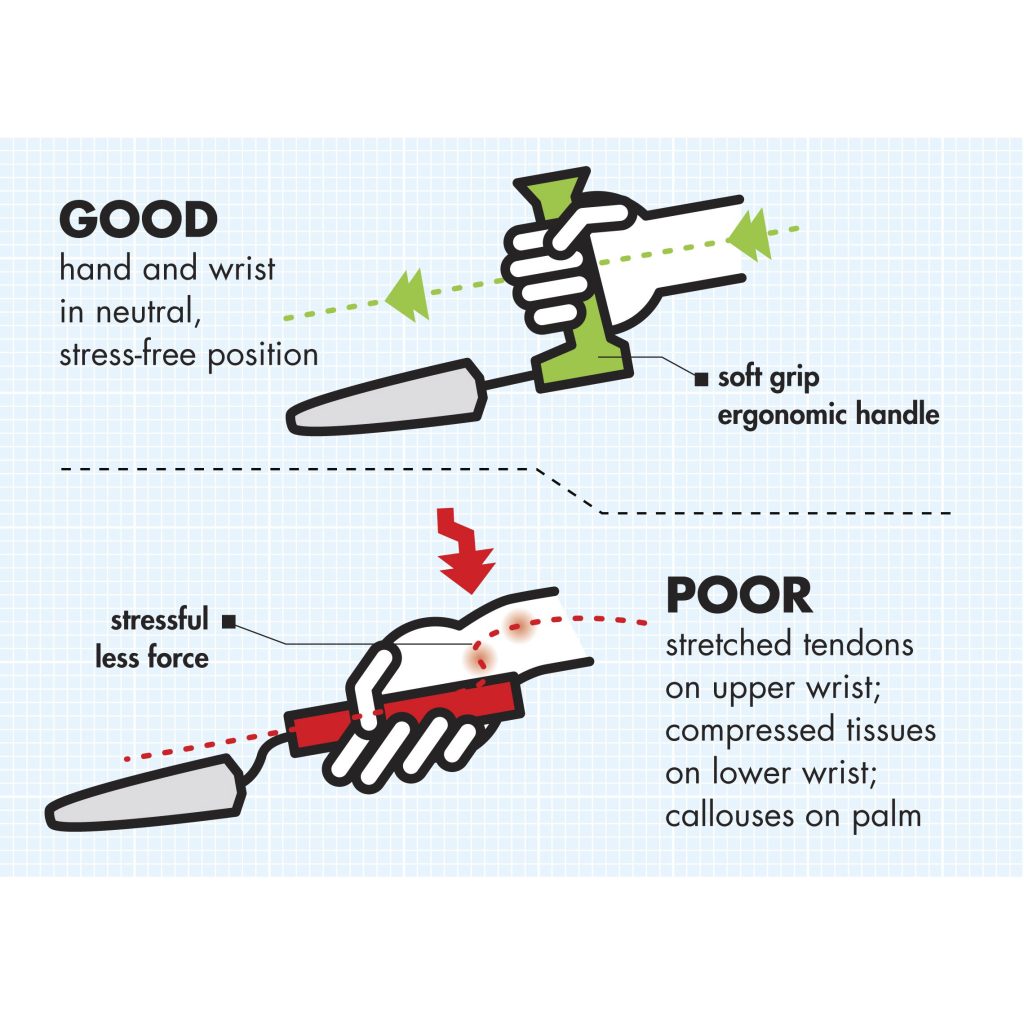
Take Peta’s Easi-Grip® hand tools for example. They have the handles at 90° from the working end of the tools, thus ensuring that your hand and wrist are in a neutral, stress-free position while working. Conventional type tools have the handles ‘in line’ with the tool. This can cause stretched tendons on the upper wrist and compressed tissues on the lower wrist, they also require to be pushed into the ground, with the palm or ball of the hand which could cause hard skin or even blisters. Easi-Grips® prevent this from happening and the work requires less effort for the same results.
Long shafted tools such as hoes and rakes again should be light, well balanced and long enough for you to work in an upright position. You should avoid excessive twisting and bending particularly when using a rake or hoe (see Figure 3). When using long shafted tools, always have one foot in front of the other with the rear knee slightly bent; this enables you to rock your weight from one foot to the other as you work.
As previously mentioned a ‘push-pull’ type of hoe that does not require lifting between strokes is an excellent tool, particularly if fitted with the Easi-Grip® Add-On Handles to keep the hands in a neutral position. It is also a good idea to fit additional handles to forks and spades, which greatly assists lifting, keeping the hand and wrist in a neutral position.
This Blog is an extract from “Gardening Body Sense” – a paper written by Lionel Crockett c. 1993.
